This is a read-only HTML export from Bentowise. You can also create your own Bentowise board, save it locally as an HTML file, or publish it online.
see Bentowise

Oscar-Claude Monet (UK: /ˈmɒneɪ/, US: /moʊˈneɪ, məˈ-/; French: [klod mɔnɛ]; 14 November, 1840 – 5 December, 1926) was a French painter and founder of Impressionism who is seen as a key precursor to modernism, especially in his attempts to paint nature as he perceived it.[1] During his long career, he was the most consistent and prolific practitioner of Impressionism's philosophy of expressing one's perceptions of nature, especially as applied to plein air (outdoor) landscape painting.[2] The term "Impressionism" is derived from the title of his painting Impression, Sunrise (Impression, soleil levant), which was exhibited in 1874 at the First Impressionist Exhibition, initiated by Monet and a number of like-minded artists as an alternative to the Salon.


Impression, Sunrise (Impression, soleil levant)
1872
the painting that gave its name to the style and artistic movement.
Paris
Monet was raised in Le Havre, Normandy, and became interested in the outdoors and drawing from an early age. Although his mother, Louise-Justine Aubrée Monet, supported his ambitions to be a painter, his father, Claude-Adolphe, disapproved and wanted him to pursue a career in business. He was very close to his mother, but she died in January 1857 when he was sixteen years old, and he was sent to live with his childless, widowed but wealthy aunt, Marie-Jeanne Lecadre. He went on to study at the Académie Suisse, and under the academic history painter Charles Gleyre, where he was a classmate of Auguste Renoir. His early works include landscapes, seascapes, and portraits, but attracted little attention. A key early influence was Eugène Boudin, who introduced him to the concept of plein air painting. From 1883, Monet lived in Giverny, also in northern France, where he purchased a house and property and began a vast landscaping project, including a water-lily pond.


Study of a Figure Outdoors: Woman with a Parasol, Facing Left,
1886,
Monet's ambition to document the French countryside led to a method of painting the same scene many times so as to capture the changing of light and the passing of the seasons. Among the best-known examples are his series of haystacks (1890–1891), paintings of Rouen Cathedral (1892–1894), and the paintings of water lilies in his garden in Giverny, which occupied him for the last 20 years of his life. Frequently exhibited and successful during his lifetime, Monet's fame and popularity soared in the second half of the 20th century when he became one of the world's most famous painters and a source of inspiration for a burgeoning group of artists.


Pierre-Auguste Renoir (/rɛnˈwɑːr/;[1] French: [pjɛʁ oɡyst ʁənwaʁ]; 25 February 1841 – 3 December 1919) was a French artist who was a leading painter in the development of the Impressionist style. It has been said that, as a celebrator of beauty and especially feminine sensuality, "Renoir is the final representative of a tradition which runs directly from Rubens to Watteau."[2]
He was the father of the actor Pierre Renoir (1885–1952), the filmmaker Jean Renoir (1894–1979) and the ceramic artist Claude Renoir (1901–1969). He was the grandfather of the filmmaker Claude Renoir (1913–1993), son of Pierre.


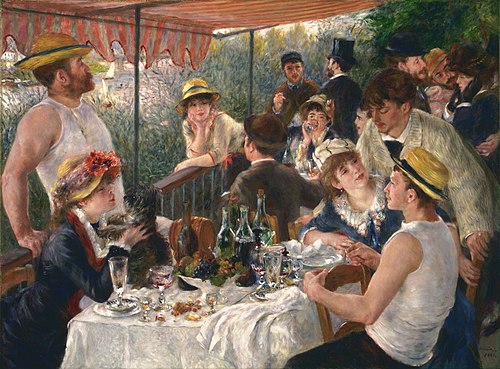
Luncheon of the Boating Party
Medium: Oil on canvas
Dimensions: 129.9 cm × 172.7 cm (51 in × 68 in)
Two Sisters (On the Terrace), oil on canvas, 1881, Art Institute of Chicago

Portrait of Jeanne Samary, 1877, Pushkin Museum, Moscow

Children at the Beach at Guernsey, 1883, Barnes Foundation, Philadelphia


Berthe Marie Pauline Morisot
Berthe Marie Pauline Morisot (French: [bɛʁt mɔʁizo]; 14 January 1841 – 2 March 1895) was a French painter, printmaker and a member of the circle of painters in Paris who became known as the Impressionists.
Morisot was married to Eugène Manet, the brother of her friend and colleague Édouard Manet.[3]
She was described by art critic Gustave Geffroy in 1894 as one of "les trois grandes dames" (The three great ladies) of Impressionism alongside Marie Bracquemond and Mary Cassatt.[4]
Impressionists
In 1864, Morisot exhibited for the first time in the highly esteemed Salon de Paris, listed as a student of Joseph Guichard and Achille-Francois Oudinot. Her work was selected for exhibition in six subsequent Salons[1] until, in 1874, she joined the "rejected" Impressionists in the first of their own exhibitions (15 April – 15 May 1874), which included Paul Cézanne, Edgar Degas, Claude Monet, Camille Pissarro, Pierre-Auguste Renoir and Alfred Sisley.
It was held at the studio of the photographer Nadar. Morisot went on to participate in all but one of the following eight impressionist exhibitions, between 1874 and 1886.[2]

Eugène Manet
Édouard Manet
Edgar Degas
Claude Monet
Summer's Day (Jour d'été), 1879, National Gallery, London

Portrait de Mme Morisot et de sa fille Mme Pontillon ou La lecture
(The Mother and Sister of the Artist – Marie-Joséphine & Edma) 1869/70

Child among the Hollyhocks (Enfant dans les roses trémières), 1881, Wallraf-Richartz Museum, Cologne

La Coiffure, 1894
